


Filter
Select quantity

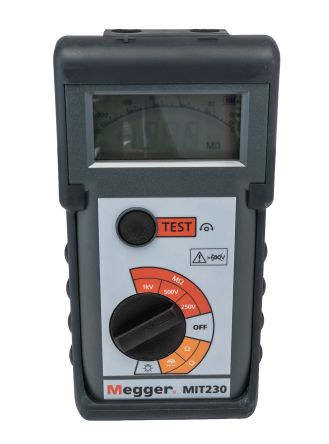
Megger MIT230HD Insulation & Continuity Tester, 250 V Min, 1000 V Max, 1000 mΩ CAT III
RS Stock No. 265-5914
Brand Megger
- Maximum Test Voltage: 1000V
- Safety Category Level: CAT III
- Tester Type: Insulation & Continuity Tester
AED 3.486.22
in stock now
View more
What is a Megger insulation tester 1000V?
A Megger insulation tester 1000V is a portable electrical test instrument used to measure insulation resistance (IR) of electrical equipment, cables, and installations. It applies a precise DC voltage up to 1000 volts to a device under test and measures how well the insulation resists leakage current. This helps identify deteriorated or damaged insulation before faults develop.
- Primary purpose: verify insulation integrity of motors, transformers, cables, switchgear, and enclosures.
- Typical output: DC test voltage up to 1000 V and IR measurements ranging from a few kilohms to gigohms depending on the model and test time.
- Key benefits: early fault detection, reduced risk of electrical shock or fire, and informed maintenance planning.
Which Megger insulation tester 1000V models are commonly used in industry?
Megger offers several insulation testers that cover 1000 V test ranges and above, with the MIT family and other Megger lines being popular in industrial maintenance. Common choices include:
- MIT series insulation testers (e.g., MIT400/MIT520) that provide 250–1000 V ranges, large displays, and data logging capabilities.
- Higher-end models that combine insulation testing with leak-current and hipot testing for more comprehensive electrical safety verification.
- Compact, portable testers ideal for field service, as well as benchtop models designed for workshop use.
How do I choose the right insulation tester 1000V for my project?
Choosing the right insulation tester depends on the equipment under test, the environment, and the data needs of your team. Consider:
- Voltage range: ensure the device supports 1000 V DC and offers lower voltages for routine testing.
- Accuracy and resolution: higher resolution helps detect small changes in insulation condition.
- Display and data storage: a clear LCD/LED readout and the ability to store test results or transfer to a PC.
- Safety features: auto-discharge, insulation test interlock, overload protection, and compliant safety approvals (IEC 61010-1 or equivalent).
- Connectivity: USB or Bluetooth data transfer if you need digital records for asset management.
- Accessory ecosystem: availability of test leads, adapters, carrying cases, and calibration services.
How do I perform an insulation resistance test safely with a 1000V Megger?
Safety is paramount when performing insulation testing. Follow these best practices:
- De-energize and isolate the equipment, then discharge any stored energy.
- Inspect test leads and probes for damage; use CAT-rated or IEC-compliant leads and PPE as appropriate.
- Connect the test leads according to the equipment’s wiring diagram, observing correct polarity if required.
- Set the test voltage to the chosen level (up to 1000 V DC) and select a suitable test duration.
- Initiate the test and monitor the IR reading; avoid touching exposed conductors during testing.
- After the test, discharge the device safely, remove test leads, and document results.
What accessories should I pair with a Megger 1000V insulation tester?
The right accessories enhance usability and accuracy. Consider:
- Test leads and remote probes with proper insulation ratings and shielding for noise reduction.
- Alligator clips, crocodile clips, or hook clips for secure connections on varying conductor sizes.
- Carrying case or holster, strap or belt clip for field use, and a calibration certificate for traceability.
- Calibration and verification kits to satisfy internal quality assurance requirements.
- USB data cables or Bluetooth dongles for transferring results to a PC or mobile device.
- Extra batteries or an external power supply if the tester supports portable operation.