Technical Documents
Specifications
Brand
BroadcomMount Type
Surface
Product Type
Optocoupler
Number of Channels
1
Number of Pins
8
Typical Rise Time
1.7μs
Maximum Input Current
230mA
Minimum Operating Temperature
-40°C
Maximum Operating Temperature
105°C
Typical Fall Time
1.7μs
Standards/Approvals
RoHS
Series
ACNT-H79B
Automotive Standard
No
Country of Origin
Philippines
Product Details
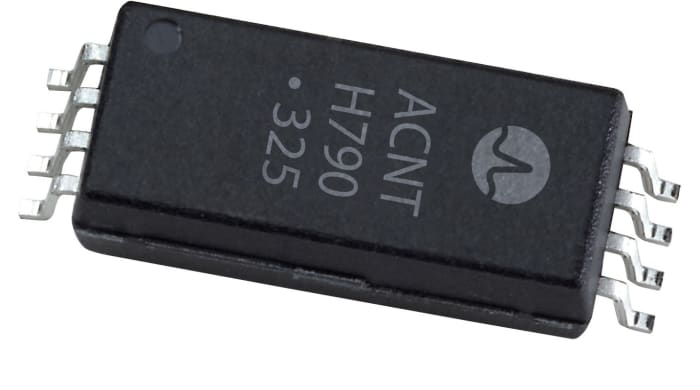
The Broadcom ACNT-H79B isolation amplifiers are designed for current and voltage sensing in electronic power converters for applications including motor drives and renewable energy systems. In a typical motor drive implementation, current flows through an external resistor and the resulting analog voltage drop is sensed by the isolation amplifier. A differential output voltage that is proportional to the current is created on the other side of the optical isolation barrier.
Stock information temporarily unavailable.
AED 76.93
AED 76.93 Each (ex VAT)
AED 80.78
AED 80.78 Each (inc. VAT)
Standard
1
AED 76.93
AED 76.93 Each (ex VAT)
AED 80.78
AED 80.78 Each (inc. VAT)
Stock information temporarily unavailable.
Standard
1
| Quantity | Unit price |
|---|---|
| 1 - 9 | AED 76.93 |
| 10 - 49 | AED 66.39 |
| 50 - 79 | AED 54.78 |
| 80+ | AED 49.17 |
Technical Documents
Specifications
Brand
BroadcomMount Type
Surface
Product Type
Optocoupler
Number of Channels
1
Number of Pins
8
Typical Rise Time
1.7μs
Maximum Input Current
230mA
Minimum Operating Temperature
-40°C
Maximum Operating Temperature
105°C
Typical Fall Time
1.7μs
Standards/Approvals
RoHS
Series
ACNT-H79B
Automotive Standard
No
Country of Origin
Philippines
Product Details
The Broadcom ACNT-H79B isolation amplifiers are designed for current and voltage sensing in electronic power converters for applications including motor drives and renewable energy systems. In a typical motor drive implementation, current flows through an external resistor and the resulting analog voltage drop is sensed by the isolation amplifier. A differential output voltage that is proportional to the current is created on the other side of the optical isolation barrier.