
Technical Documents
Specifications
Brand
FlukeProduct Type
EV Charger Test Adapter
Connector Type
Type 1 & 2
Series
FEV300
Weight
1kg
Better World Product
Yes
Better World Claim
Renewable Energy Solution
Country of Origin
Slovenia
Product Details
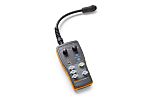
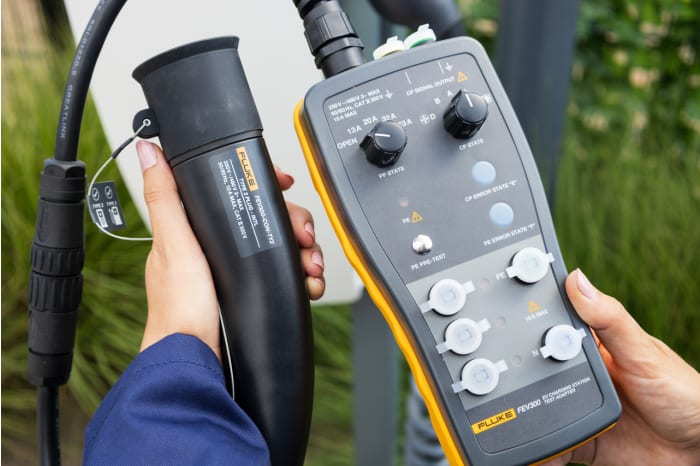
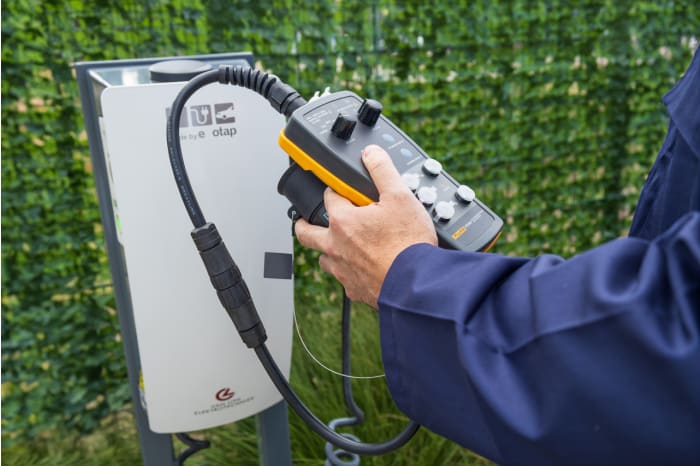
This EV charger test adaptor is a portable tool that simulates an electric vehicle to initiate and evaluate AC charging cycles for mode-3 charging stations. It connects to Type 1 and Type 2 charging interfaces and provides measured outputs and signal connections so technicians can verify functionality and safety of EV charging equipment in accordance with relevant charging protocols.
Three separate LEDs show each phase independently to verify voltage presence at the charging outputs.
It can force a CP error by shorting CP to PE and simulate an earth fault by interrupting the PE conductor.
CP voltages include +12 V, +9 V, +6V and +3V with PWM variations around these levels to represent different vehicle states.
Installation testers, clamp meters, multimeters and handheld oscilloscopes can be connected to the L1, L2, L3, N and PE terminals for measurements.
Operates between -20 °C and 40 °C, up to 2,000m altitude, 10%–85% relative humidity non‑condensing, and maximum internal consumption of 3 W.

Stock information temporarily unavailable.
AED 3,377.46
AED 3,377.46 Each (ex VAT)
AED 3,546.33
AED 3,546.33 Each (inc. VAT)
1
AED 3,377.46
AED 3,377.46 Each (ex VAT)
AED 3,546.33
AED 3,546.33 Each (inc. VAT)
Stock information temporarily unavailable.
1
Technical Documents
Specifications
Brand
FlukeProduct Type
EV Charger Test Adapter
Connector Type
Type 1 & 2
Series
FEV300
Weight
1kg
Better World Product
Yes
Better World Claim
Renewable Energy Solution
Country of Origin
Slovenia
Product Details
This EV charger test adaptor is a portable tool that simulates an electric vehicle to initiate and evaluate AC charging cycles for mode-3 charging stations. It connects to Type 1 and Type 2 charging interfaces and provides measured outputs and signal connections so technicians can verify functionality and safety of EV charging equipment in accordance with relevant charging protocols.
Three separate LEDs show each phase independently to verify voltage presence at the charging outputs.
It can force a CP error by shorting CP to PE and simulate an earth fault by interrupting the PE conductor.
CP voltages include +12 V, +9 V, +6V and +3V with PWM variations around these levels to represent different vehicle states.
Installation testers, clamp meters, multimeters and handheld oscilloscopes can be connected to the L1, L2, L3, N and PE terminals for measurements.
Operates between -20 °C and 40 °C, up to 2,000m altitude, 10%–85% relative humidity non‑condensing, and maximum internal consumption of 3 W.