Technical Document
Specifications
Brand
RS ProProduct Type
3D Printer Filament
Material Type
ABS
Printing Technology
Fused Deposition Modelling (FDM)
Machine Specific
No
Colour
White
For Use With
Common Desktop 3D Printers
Weight
1kg
Diameter
1.75mm
Printing Material
ABS
Printing Minimum Temperature
220°C
Printing Maximum Temperature
270°C
Standards/Approvals
No
Country of Origin
Spain
Product details
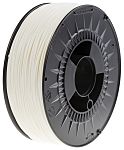
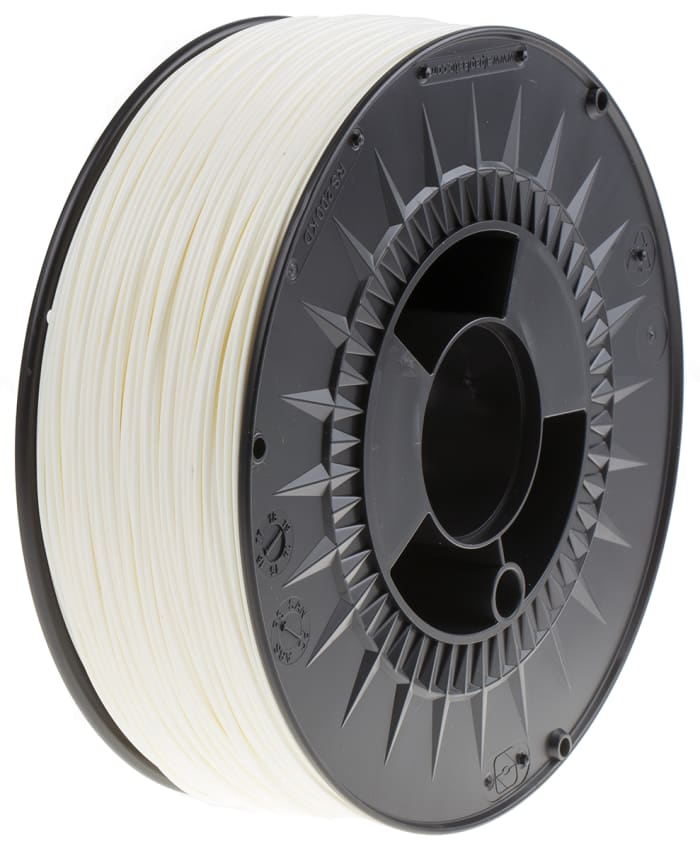
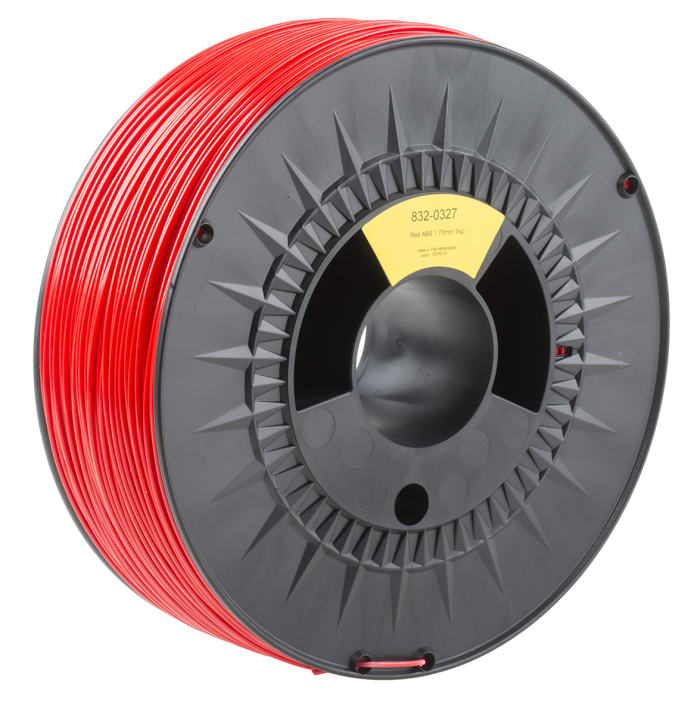
This ABS (Acrylonitrile Butadiene Styrene) from our high-quality own brand RS PRO is a durable impact-resistant filament which is ideal for 3D printing of solid printed products. RS PRO ABS filament is specifically formulated to minimize warping and ensure consistent interlayer adhesion.
RS PRO ABS filament can be used in visual and functional prototyping and short-run manufacturing.
Once you've purchased your filament it’s important to store it correctly to maintain its quality. Over time the plastic will absorb moisture from the air, creating small water bubbles in the filament. These bubbles, when heated in the extruder nozzle, will quickly reach boiling point, spoiling the print. The use of desiccant dehumidifiers to absorb the moisture is highly recommended.
Does your printer have a heated bed? Is the bed capable of reaching temperatures more than 100°C? ABS tend to warp and peel and often won’t stick well to an unheated or underheated print bed. If you have an unheated bed or one that doesn’t get hot enough, you’ll probably want to stick with PLA.
Does your printer have a cooling fan blowing directly at the print area near the end of the nozzle? If it does, you’re probably good to go with either material; if not, ABS may be a better choice. PLA has a tendency to curl at corners and overhangs, which can be minimized with proper cooling. While good cooling helps both, ABS may fare better without a fan.
ABS adhere best when printed on a bed covered with polyamide tape. If you decide to purchase one, it will go a long way and can be replaced less frequently.
RS PRO is our own brand range and brings you a wide range of high-quality, great value products offering you more choice. Trusted by engineers all over the world, every part of every RS PRO product has been rigorously tested against demanding industry standards; they’re only given the RS PRO Seal of Approval if we’re confident of their exceptional quality, which means you can be confident too.
FAQs
What material can be used in 3D Printing?
Various materials can be used for 3D printing which includes:
PLA, ABS, polyamide (nylon), glass filled polyamide, resins, silver, titanium, steel, wax, photopolymers and polycarbonate (PC), PP or polypropylene, PET, PEEK.
What is the least expensive 3D printing material?
PLA and ABS are the least expensive.


Stock information temporarily unavailable.
AED 253.22
AED 253.22 Each (ex VAT)
AED 265.88
AED 265.88 Each (inc. VAT)
1
AED 253.22
AED 253.22 Each (ex VAT)
AED 265.88
AED 265.88 Each (inc. VAT)
Stock information temporarily unavailable.
1
| Quantity | Unit price |
|---|---|
| 1 - 2 | AED 253.22 |
| 3+ | AED 247.33 |
Technical Document
Specifications
Brand
RS ProProduct Type
3D Printer Filament
Material Type
ABS
Printing Technology
Fused Deposition Modelling (FDM)
Machine Specific
No
Colour
White
For Use With
Common Desktop 3D Printers
Weight
1kg
Diameter
1.75mm
Printing Material
ABS
Printing Minimum Temperature
220°C
Printing Maximum Temperature
270°C
Standards/Approvals
No
Country of Origin
Spain
Product details
This ABS (Acrylonitrile Butadiene Styrene) from our high-quality own brand RS PRO is a durable impact-resistant filament which is ideal for 3D printing of solid printed products. RS PRO ABS filament is specifically formulated to minimize warping and ensure consistent interlayer adhesion.
RS PRO ABS filament can be used in visual and functional prototyping and short-run manufacturing.
Once you've purchased your filament it’s important to store it correctly to maintain its quality. Over time the plastic will absorb moisture from the air, creating small water bubbles in the filament. These bubbles, when heated in the extruder nozzle, will quickly reach boiling point, spoiling the print. The use of desiccant dehumidifiers to absorb the moisture is highly recommended.
Does your printer have a heated bed? Is the bed capable of reaching temperatures more than 100°C? ABS tend to warp and peel and often won’t stick well to an unheated or underheated print bed. If you have an unheated bed or one that doesn’t get hot enough, you’ll probably want to stick with PLA.
Does your printer have a cooling fan blowing directly at the print area near the end of the nozzle? If it does, you’re probably good to go with either material; if not, ABS may be a better choice. PLA has a tendency to curl at corners and overhangs, which can be minimized with proper cooling. While good cooling helps both, ABS may fare better without a fan.
ABS adhere best when printed on a bed covered with polyamide tape. If you decide to purchase one, it will go a long way and can be replaced less frequently.
RS PRO is our own brand range and brings you a wide range of high-quality, great value products offering you more choice. Trusted by engineers all over the world, every part of every RS PRO product has been rigorously tested against demanding industry standards; they’re only given the RS PRO Seal of Approval if we’re confident of their exceptional quality, which means you can be confident too.
FAQs
What material can be used in 3D Printing?
Various materials can be used for 3D printing which includes:
PLA, ABS, polyamide (nylon), glass filled polyamide, resins, silver, titanium, steel, wax, photopolymers and polycarbonate (PC), PP or polypropylene, PET, PEEK.
What is the least expensive 3D printing material?
PLA and ABS are the least expensive.